
Table of Contents
Introduction
Getting website traffic is easy compared with turning the right visitors into genuine business opportunities.
Many businesses invest in SEO, Google Ads, Meta Ads, social media and content but still struggle with inconsistent enquiries. The problem is usually not a lack of marketing activity. The problem is that those activities are not connected to a complete lead generation system.
Lead generation is the process of attracting potential customers, capturing their interest and contact information, qualifying their requirements and moving them towards a sales conversation.
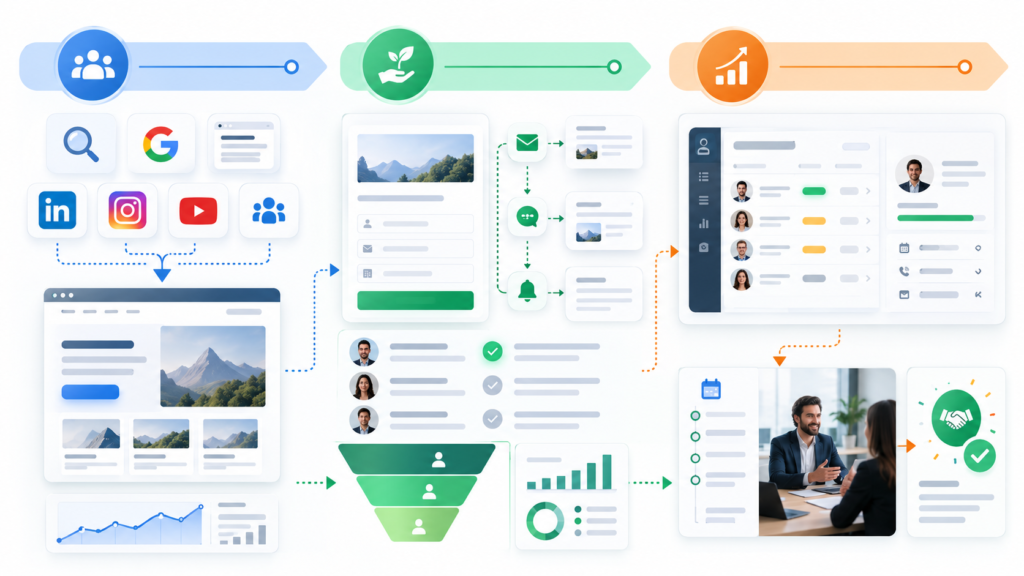
In 2026, effective lead generation strategies must cover the complete customer journey. Businesses need visibility when prospects discover a problem, useful information while they compare options, and strong conversion paths when they are ready to enquire.
That is where the TOFU → MOFU → BOFU model becomes valuable.
TOFU creates awareness. MOFU builds trust and consideration. BOFU converts buying intent into enquiries and sales.
For businesses, especially B2B companies, manufacturers and service providers, the goal is no longer to collect the highest possible number of leads. It is to build a predictable system capable of generating relevant prospects who have a realistic chance of becoming customers.
What Is Lead Generation?
Lead generation means attracting people or businesses that may need your product or service and encouraging them to take an identifiable action, such as submitting an enquiry, requesting a quotation, booking a consultation, calling your business or messaging you on WhatsApp.
Modern online lead generation can come from Google Search, SEO, paid advertising, LinkedIn, Meta platforms, email, content, referrals, local search and AI-assisted search journeys.
A visitor, however, is not automatically a valuable lead.
Good lead generation marketing connects four things:
Right Audience → Right Problem → Right Offer → Right Action
For example, imagine a textile manufacturer trying to attract garment manufacturers. Getting 5,000 general fashion visitors may create little business value. Attracting 100 purchasing managers searching for a specific fabric specification could create considerably stronger sales opportunities.
That difference between traffic and intent should guide every campaign.
Why Lead Generation for Businesses Is Changing in 2026
The traditional journey of “search Google → open website → submit form” is becoming more fragmented.
Potential customers can discover a company through Google, Maps, LinkedIn, Instagram, YouTube, industry portals, review platforms and AI assistants. They may compare several providers before contacting anyone.
This means lead generation for businesses needs to work across multiple discovery and evaluation points.
Your website should not simply rank. It should clearly communicate who you help, what you offer, where you operate, why buyers should trust you and what they should do next.
This is also important for GEO, or Generative Engine Optimization. Clear definitions, specific expertise, factual information, case studies, author information, service details, FAQs and structured answers help make content easier for both people and AI-driven discovery systems to interpret.
TOFU: Attract People Who Have the Right Problem
TOFU stands for Top of Funnel.
At this stage, potential customers may know their problem but may not yet know your company or even the exact solution they need.
The objective is therefore not aggressive selling. It is visibility and education.
1. SEO and Search-Focused Content
SEO remains one of the strongest long-term digital lead generation methods because it connects your business with users actively researching a problem, product or service.
Instead of targeting only commercial terms such as “lead generation company,” cover the questions prospects ask before reaching that stage.
Examples include:
“What is lead generation?”
“How can I get B2B leads?”
“SEO vs Google Ads for leads”
“How much should a business spend on lead generation?”
This creates topical depth while allowing potential customers to discover your expertise earlier.
For GEO, give direct answers near the beginning of each important section, use descriptive headings, add real examples and demonstrate first-hand experience rather than producing generic content.
2. Social Media and Educational Content
Social platforms work well at TOFU when content identifies a problem the target audience already experiences.
This is where the PAS framework — Problem, Agitate, Solution — works naturally.
Problem: Your campaigns generate enquiries but few qualified buyers.
Agitate: Your sales team spends valuable time calling people who have no budget, requirement or buying intent.
Solution: Improve audience targeting, qualification questions, landing pages and lead scoring before sending prospects to sales.
This format gets attention because it starts with the customer’s situation instead of your service.
3. Local and Industry Visibility
For lead generation for small businesses, local SEO can be extremely important.
Optimize your Google Business Profile, location pages, services, reviews, images and consistent business information. Manufacturers and B2B companies should also build visibility around industries, products, applications and geographic markets their buyers actually search.
TOFU should make the right audience aware that you understand their problem.

MOFU: Turn Attention Into Trust
MOFU stands for Middle of Funnel.
Here, prospects already understand their problem. Now they are researching solutions and comparing providers.
This is where E-E-A-T becomes particularly important.
Build E-E-A-T Into Your Content
Experience: Show work you have actually completed.
Expertise: Explain processes, challenges and solutions in depth.
Authoritativeness: Build strong topic coverage, relevant mentions and credible references.
Trust: Show transparent company information, contact details, team expertise, testimonials, policies and realistic claims.
Case studies are especially valuable because they move content from “we know marketing” to “here is how we approached a real marketing challenge.”
4. Use Lead Magnets With Real Buying Value
A lead magnet should solve a small but meaningful problem.
Depending on the business, that could be:
ROI calculator
Product catalogue
Pricing guide
Technical specification sheet
Audit
Comparison guide
Sample request
Consultation
These lead generation techniques exchange useful information for contact details while helping identify what the prospect is interested in.
5. Use the AIDA Framework to Nurture Leads
MOFU content can follow AIDA: Attention, Interest, Desire, Action.
Attention: Address the customer’s biggest concern.
Interest: Explain why the problem occurs.
Desire: Demonstrate a practical solution using expertise, proof or examples.
Action: Give the user a logical next step.
For example, a B2B manufacturer may attract a buyer with an article, build interest using a technical comparison, create desire through product specifications and quality proof, and then invite the buyer to request a sample.
That is much stronger than placing “Contact Us” everywhere without understanding buyer readiness.

BOFU: Convert High-Intent Prospects Into Leads
BOFU means Bottom of Funnel.
These prospects are closer to making a decision. Your job is to reduce friction and provide enough confidence for them to act.
6. Google Ads for High-Intent Searches
Google Ads can capture prospects searching terms such as:
“manufacturer”
“supplier”
“quotation”
“agency”
“service near me”
“price”
These searches often indicate stronger commercial intent than broad informational queries.
Paid search works especially well when each important intent has a dedicated landing page rather than sending every visitor to the homepage.
7. Build Conversion-Focused Landing Pages
A good landing page should answer five questions quickly:
What do you offer?
Who is it for?
What problem does it solve?
Why should the buyer trust you?
What should they do next?
Use a strong headline, relevant benefits, proof, FAQs and one primary CTA.
Keep forms proportional to intent. A TOFU download may require only basic information. A BOFU quotation form can reasonably ask about quantity, service requirement, location, budget or timeline.
8. Use LinkedIn and Account-Based Marketing for B2B
B2B lead generation often requires greater precision because one customer may represent significant revenue.
LinkedIn prospecting, thought leadership, targeted advertising and Account-Based Marketing allow businesses to focus on defined companies and decision-makers rather than broad audiences.
Manufacturers could target sourcing heads, procurement managers and business owners. Professional service companies could target founders, marketing leaders or department heads.
Personalization matters more than volume.

Lead Generation Methods That Work Better Together
There is no universal channel that should handle your entire funnel.
The strongest lead generation methods work as a connected system.
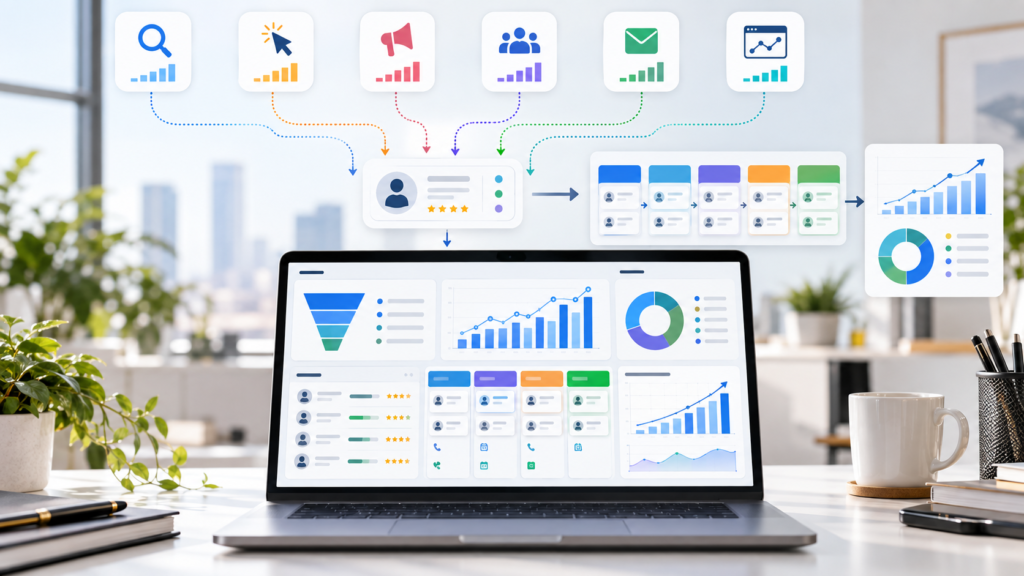
SEO and content build long-term visibility. Google Ads capture immediate search intent. Meta Ads create and retarget demand. LinkedIn supports professional and B2B targeting. Email and WhatsApp help nurture prospects. Landing pages convert demand. CRM systems organize follow-up.
A prospect might first read your blog, later see a remarketing ad, review a case study, search your company name and finally submit a quotation request.
Attribution may show only the last click, but multiple touchpoints helped create the conversion.
What Is the Best Lead Generation Strategy in 2026?
The best strategy is not one channel. It is a funnel:
TOFU: SEO + GEO + educational content + social discovery
MOFU: Case studies + comparisons + lead magnets + remarketing
BOFU: Google Ads + landing pages + consultations + quotation forms + sales follow-up
This structure makes lead generation strategies 2026 more focused on buyer intent than simply generating traffic.
The exact channel mix should depend on your audience, margins, buying cycle, location and average customer value.
How to Measure Lead Generation Performance
Do not judge campaigns only by total leads.
Track metrics that connect marketing activity with actual business outcomes:
Cost per lead
Qualified lead rate
Landing page conversion rate
Cost per qualified lead
Meeting or quotation rate
Lead-to-customer conversion
Customer acquisition cost
Revenue generated by channel
A campaign producing 20 highly relevant enquiries can be far more valuable than one producing 200 low-intent form submissions.
Lead Generation for Small Businesses
The biggest mistake in lead generation for small businesses is trying to use every available channel at once.
Start where customer intent is strongest.
A local service business could begin with Google Business Profile, local SEO and Google Ads. A manufacturer may combine product SEO, Google Ads, LinkedIn and WhatsApp follow-up. A professional service provider could build around SEO, educational content, LinkedIn and consultation landing pages.
Master a small number of channels, measure lead quality and expand only when the economics make sense.
Conclusion
Successful lead generation is not about collecting contact details from as many people as possible. It is about attracting the right audience, answering their questions, building trust and creating a clear path from discovery to enquiry.
Businesses that connect TOFU → MOFU → BOFU, use E-E-A-T to establish credibility, apply PAS to communicate customer problems and AIDA to guide action can build a stronger and more measurable acquisition system.
The strongest approach combines SEO, GEO, paid media, useful content, landing pages, remarketing, CRM tracking and fast sales follow-up instead of treating each activity separately.
If your business wants to build a structured system for attracting and converting qualified prospects, Badiya Brand can help create a performance-focused lead generation strategy built around your audience, market and growth goals.
Frequently Asked Questions About Lead Generation
A simple classification is cold, warm and hot leads. Cold prospects have limited awareness or intent, warm leads have shown interest, and hot leads demonstrate stronger buying intent.
Define your target customer, understand search and buying intent, select acquisition channels, create useful content or offers, build conversion pages, capture enquiries, qualify leads, follow up, measure sales outcomes and optimize the funnel.
Businesses commonly use SEO platforms, Google Ads, Meta Ads, LinkedIn, landing-page software, analytics tools, CRM systems, email automation and WhatsApp-based communication tools. The best stack depends on your funnel rather than the number of tools available.
A B2B enquiry form can include name, company name, phone number, email, required product or service, quantity or budget, location and a short requirement field. Ask only for information that helps qualification or the next sales step.